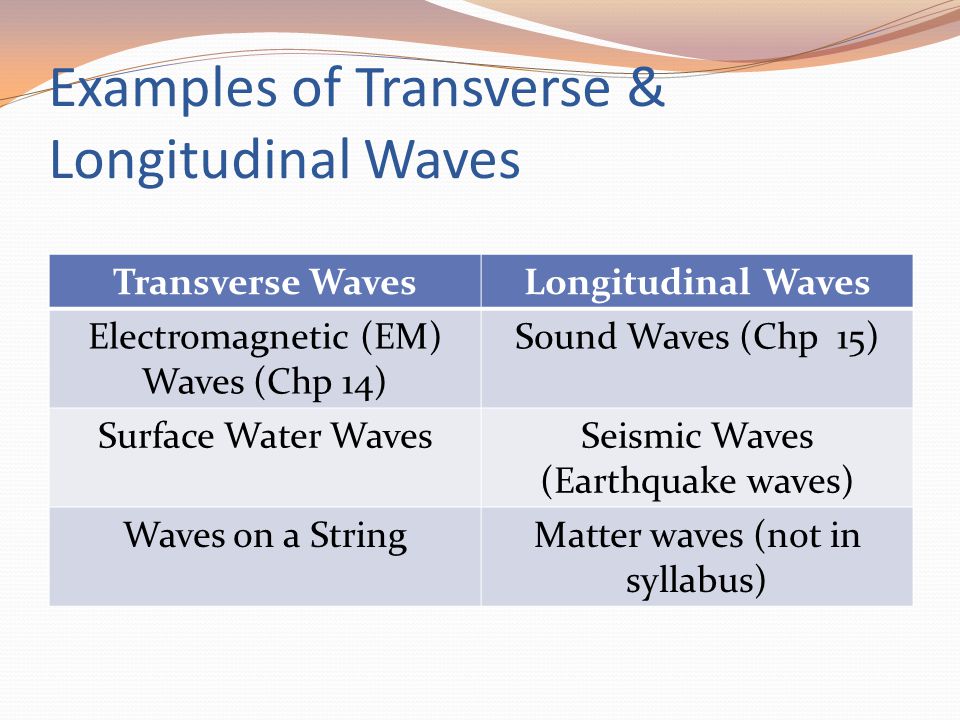
Characteristics Of Longitudinal And Transverse Waves Class 11 : The following diagrams show examples of longitudinal and transverse waves.. In this lesson, explore both types of contrast the characteristics of transverse and longitudinal waves. A transverse wave moves across air or water at a right angle to the direction in which the waves are traveling. (i) the particles of waves on strings, surface water waves and electromagnetic waves are transverse waves. For example, the seismic (earthquake) waves produced in the interior of earth travel both in the form of longitudinal and transverse waves. Transverse wave speed determined by:
The common features of longitudinal and transverse wave are as follows. How they work, their main features and properties, and the main characteristics. Transverse waves are the waves that have the classical wave shape everyone thinks of when they imagine a wave. Overview of key terms and skills for waves, including how to identify longitudinal and transverse waves. The air motion which accompanies the passage of the sound wave will be back and forth in the direction of the propagation of the sound, a characteristic of longitudinal waves.
Characteristics Of Longitudinal And Transverse Waves Class ... from slideplayer.com A string or slinky moving up and down (one end being. The compressed air in longitudinal waves corresponds to the crest, while the rarefied air corresponds to the trough. Mechanical waves are waves which propagate through a material medium (solid, liquid, or gas) at a wave speed which depends on the elastic and inertial properties of that medium. Longitudinal waves and transverse waves. Longitudinal waves are waves in which the vibration of the medium is parallel to the direction the wave travels displacement of the medium is in the same (or opposite) direction of the wave propagation. By matching up those characteristics, it is possible to render longitudinal. All the visitors can prepare for their 11th class examination by attempting below given question answers. Here is a brief video.
Longitudinal waves are often produced.
We've been doing a lot of work with waves. Sound waves are longitudinal mechanical waves. Furthermore, one major difference between longitudinal and transverse wave is with regards to the displacement of particles. A good longitudinal wave example is a sound wave that is. Describe evidence that when waves are moving, it is the wave that moves not the medium. Overview of key terms and skills for waves, including how to identify longitudinal and transverse waves. Here is a brief video. For example, the seismic (earthquake) waves produced in the interior of earth travel both in the form of longitudinal and transverse waves. Speed of a transverse wave in a stretched string. Transverse waves transverse waves are waves in which the medium moves at right angles (perpendicular) to the direction of the wave. All the visitors can prepare for their 11th class examination by attempting below given question answers. Transverse waves and longitudinal waves are two waves that are classified based on vibrations of particles of the medium. Notes, important questions, formulas, important terms, superposition of waves class 11 waves have a set of characteristics that have been elucidated in the waves class 11 chapter.
We've been doing a lot of work with waves. Furthermore, this type of wave is bifurcated into 2 types, transverse and longitudinal. Imagine securing one end of a slinky to a wall. How they work, their main features and properties, and the main characteristics. Sound waves are longitudinal mechanical waves.
ClaimParse from claimparse.com These waves are also produced. Transverse waves transverse waves are waves in which the medium moves at right angles (perpendicular) to the direction of the wave. In this list we have included all punjab answer : Imagine securing one end of a slinky to a wall. For transverse waves the displacement of the medium is perpendicular to the direction of propagation of the wave. Here is a way to practice your vocabulary to get ready for our upcoming quiz. Longitudinal vs transverse wave a wave is a disturbance which moves away from what created it and changes the thing that it travels on like the surface of the ocean or the air. The compressed air in longitudinal waves corresponds to the crest, while the rarefied air corresponds to the trough.
In this lesson, explore both types of contrast the characteristics of transverse and longitudinal waves.
But, longitudinal waves are just as important, and understanding the difference is vital to learning about waves. (i) the particles of waves on strings, surface water waves and electromagnetic waves are transverse waves. A good longitudinal wave example is a sound wave that is. Now stretch out the slinky by holding onto one end. Like transverse waves, longitudinal waves are mechanical waves, which means they transfer energy through a medium. The air motion which accompanies the passage of the sound wave will be back and forth in the direction of the propagation of the sound, a characteristic of longitudinal waves. By matching up those characteristics, it is possible to render longitudinal. This is because when it travels in air, the particles move back and forth, and the pressure of the air changes, hence giving birth to a. Longitudinal waves are waves in which the vibration of the medium is parallel to the direction the wave travels displacement of the medium is in the same (or opposite) direction of the wave propagation. Transverse means crosswise or extending across something. For example, the seismic (earthquake) waves produced in the interior of earth travel both in the form of longitudinal and transverse waves. A transverse wave moves across air or water at a right angle to the direction in which the waves are traveling. For transverse waves the displacement of the medium is perpendicular to the direction of propagation of the wave.
Longitudinal vs transverse wave a wave is a disturbance which moves away from what created it and changes the thing that it travels on like the surface of the ocean or the air. Longitudinal waves are often produced. Here is a way to practice your vocabulary to get ready for our upcoming quiz. Transverse means crosswise or extending across something. Most people don't usually picture longitudinal waves when they think of a wave.
'sound waves' on SlideShare from cdn.slidesharecdn.com Identifying transverse and longitudinal waves. Here is a brief video. Now stretch out the slinky by holding onto one end. For transverse waves the displacement of the medium is perpendicular to the direction of propagation of the wave. Transverse means crosswise or extending across something. Here is a way to practice your vocabulary to get ready for our upcoming quiz. Displacement in a progressive wave. In this lesson, explore both types of contrast the characteristics of transverse and longitudinal waves.
A longitudinal wave is a type of wave that moves in the direction of its propagation.
There are two basic types of wave motion for mechanical waves: Transverse waves transverse waves are waves in which the medium moves at right angles (perpendicular) to the direction of the wave. Longitudinal waves are often produced. Like transverse waves, longitudinal waves are mechanical waves, which means they transfer energy through a medium. Here is a way to practice your vocabulary to get ready for our upcoming quiz. Longitudinal waves are waves in which the vibration of the medium is parallel to the direction the wave travels displacement of the medium is in the same (or opposite) direction of the wave propagation. The compressed air in longitudinal waves corresponds to the crest, while the rarefied air corresponds to the trough. Transverse wave speed determined by: A longitudinal wave is a wave that moves in the direction that it was started. Transverse means crosswise or extending across something. Furthermore, the characterization of longitudinal waves is by wave motion being parallel to particle motion. Explain why transverse waves can only. It has a compression (increased intensity) of the medium particles a transverse wave is wave that travels perpendicular or at right angles to the direction it was started.
Share :
Post a Comment
for "Characteristics Of Longitudinal And Transverse Waves Class 11 : The following diagrams show examples of longitudinal and transverse waves."


Post a Comment for "Characteristics Of Longitudinal And Transverse Waves Class 11 : The following diagrams show examples of longitudinal and transverse waves."